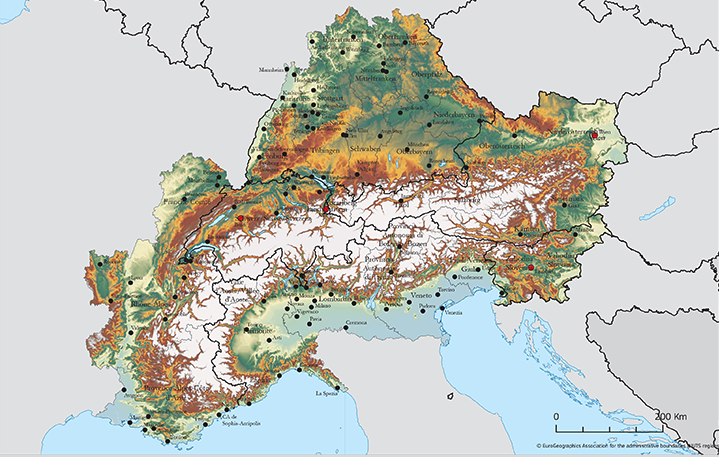
The abbreviation EUSALP stands for the EU Strategy for the Alpine Region, which has tangible effects on everday lives of people, who are living in the Alps. The “European Union Strategy for the Alpine Region” started in 2015 with the aim of improving cooperation in one of the economically strongest however most environmentally sensitive regions of the European Union. The Alps are far more than just a natural area — they are a transport corridor, an energy region, an economic hub, and a living space at the same time.

The scale of this cooperation is remarkable. EUSALP includes seven countries and 48 regions. Five of these are EU member states — Austria, France, Germany, Italy, and Slovenia — while the non-EU countries Switzerland and Principality of Liechtenstein are also involved. Together, they form a functional area that is politically different but faces similar challenges. This is where EUSALP comes in. Unlike traditional funding programs, the strategy does not have its own budget; instead, it serves as a coordination framework. It unites regions, states, and institutions to use existing EU funds more efficiently and in a more targeted way. Essential is the idea that problems should be solved across borders rather than isolated.
The key areas of focus affect everyday life for many people. One major priority is sustainable growth and innovation: how can Alpine regions remain economically strong without overloading natural resources? Another focus is mobility — for example, how transport across the Alps can be organized in an environmentally friendly way. Environmental protection, biodiversity, and climate change adaptation — especially important in the Alpine region — are also central topics.
The strategy leads to actual initiatives, ranging from innovation networks and energy projects to solutions in the fields of education and workforce development. For regions such as Carinthia, EUSALP is particularly important. As part of the Alpine region, it directly benefits from close cooperation with neighboring regions, for example in northern Italy or Slovenia. At the same time, the strategy offers regions the opportunity to make their interests visible at the EU level and to actively participate in decision making. While the European Commission provides the strategic framework, implementation is largely decentralized, with regions and local actors playing an active role. EUSALP also demonstrates how European cooperation can function beyond EU borders. The inclusion of Switzerland and Liechtenstein is a proof that such solutions in the Alpine region can only succeed if all relevant partners are involved.